Article Plan: Somewhere Over the Rainbow PDF Sheet Music
Exploring the enchanting world of “Over the Rainbow” through readily available PDF sheet music unlocks a treasure trove for musicians.
Sites like Sheetsfree.com and Musicnotes.com offer various arrangements,
primarily in C major, catering to diverse skill levels.
These resources provide access to this timeless classic.
“Over the Rainbow”, a cornerstone of American musical heritage, transcends generations with its poignant melody and hopeful lyrics. Originally penned for the 1939 film The Wizard of Oz, with music by Harold Arlen and lyrics by E.Y. Harburg, the song quickly blossomed into a standalone classic, captivating audiences worldwide. Its enduring appeal lies in its universal theme of longing for a better place, a sentiment resonating deeply with listeners of all ages.
The song’s initial impact was inextricably linked to Judy Garland’s breathtaking performance, but its beauty extends far beyond any single interpretation. Today, “Over the Rainbow” remains a staple in vocal repertoire, frequently performed and reinterpreted by artists across genres. The availability of sheet music, particularly in accessible PDF formats, has democratized access to this iconic song, allowing musicians of all levels to learn and share its magic.
Numerous online platforms, such as Sheetsfree.com and Musicnotes.com, offer various arrangements of “Over the Rainbow,” often in keys like C major, making it approachable for beginners. These resources provide a gateway for aspiring musicians to connect with this timeless masterpiece, fostering a continued appreciation for its artistry and emotional depth; The song’s simplicity belies its profound impact, making it a perfect piece for both learning and performance.
Historical Context of the Song
“Over the Rainbow” emerged from a unique period in American filmmaking and songwriting, deeply influenced by the socio-political climate of the late 1930s. Released in 1939, during the shadow of the Great Depression and the looming threat of World War II, the song offered a much-needed escape – a yearning for a brighter, more hopeful future. The Wizard of Oz, and consequently “Over the Rainbow,” provided a fantastical realm where dreams could take flight, offering solace to a nation grappling with hardship.
The song’s creation wasn’t without its challenges. Initially, producers considered cutting “Over the Rainbow” from the film, deeming it too slow and melancholic for a children’s movie. However, Judy Garland’s passionate advocacy and the song’s undeniable emotional power ultimately secured its place. The initial sheet music publication in 1939 (renewed in 1966 & 1967) reflects its immediate popularity, with rights controlled by EMI Feist Catalog Inc. and Warner Bros. Publications.
The availability of sheet music, even in its early forms, played a crucial role in disseminating the song’s message. Today, digitized PDF versions, like those found on Sheetsfree.com, continue this legacy, allowing new generations to access and interpret this historical artifact. Understanding this context enriches the appreciation for “Over the Rainbow” beyond its melodic beauty, recognizing it as a cultural touchstone of its time.
Judy Garland’s Iconic Performance
Judy Garland’s rendition of “Over the Rainbow” transcends a simple vocal performance; it’s a masterclass in emotional delivery and a defining moment in cinematic history. Her interpretation, within The Wizard of Oz, imbued the song with a vulnerability and longing that resonated deeply with audiences then and continues to do so today. The performance wasn’t merely about hitting the notes, but about conveying the character Dorothy’s yearning for a place “somewhere over the rainbow.”
Garland’s vocal control, particularly her phrasing and subtle dynamic shifts, elevated the song beyond its already beautiful melody. The emotional weight she brought to the lyrics transformed it into an anthem of hope and resilience. This iconic status is reflected in the enduring demand for sheet music arrangements, allowing aspiring singers and musicians to study and emulate her artistry.
The sheet music available, such as the PDF version on Sheetsfree.com, often includes markings and annotations that hint at the nuances of Garland’s performance. While the notation provides the skeletal structure, it’s the memory of her interpretation that breathes life into the notes. Her performance remains the gold standard, influencing countless artists and solidifying “Over the Rainbow” as her signature song.
Popularity and Cultural Impact
“Over the Rainbow” quickly ascended beyond its origins in The Wizard of Oz to become a universally recognized symbol of hope, dreams, and longing. Its enduring popularity is evidenced by its countless covers, appearances in films and television, and consistent presence on “greatest songs of all time” lists. The song’s message of seeking a better place resonates across generations and cultures, solidifying its place in the collective consciousness.
The widespread availability of sheet music, including easily accessible PDF versions like those found on Sheetsfree.com and Musicnotes.com, has contributed significantly to its continued performance and appreciation. Musicians of all levels are drawn to the song’s beauty and emotional depth, perpetuating its legacy through live performances and recordings.
Culturally, “Over the Rainbow” has become an anthem for marginalized communities, representing the pursuit of acceptance and equality. It’s frequently used in contexts of social justice and activism, demonstrating its power to inspire and unite. The song’s enduring appeal is a testament to its timeless message and the brilliance of its composition, ensuring its continued relevance for years to come.
Availability of Sheet Music – General Overview
Sheet music for “Over the Rainbow” is remarkably accessible in a variety of formats, catering to diverse musical preferences and skill levels. Traditionally, printed sheet music was the primary source, available through music stores and publishers like Musicnotes.com, which still offers a comprehensive catalog. However, the digital age has revolutionized access, with numerous websites providing downloadable PDF versions.
Websites such as Sheetsfree.com specialize in offering free sheet music, including arrangements of “Over the Rainbow” in keys like C major. These PDFs often include vocal melodies, chord symbols, and sometimes simplified piano accompaniments. Other platforms offer more elaborate arrangements, often requiring a purchase or subscription. The availability extends beyond standard notation, encompassing vocal lead sheets and chord charts.
The proliferation of online resources means that aspiring musicians can readily find sheet music suited to their needs, whether for practice, performance, or simply enjoying the song at the piano. The ease of access has undoubtedly contributed to the song’s continued popularity and widespread performance across the globe.
Sheetsfree.com PDF Sheet Music (C Major) ⸺ Detailed Analysis
The Sheetsfree.com PDF sheet music for “Over the Rainbow” in C major presents a relatively straightforward arrangement, ideal for intermediate players. The document, published on March 8, 2023, clearly displays the melody line and accompanying chord symbols. It’s a vocal chords sheet music edition, indicating a focus on vocal performance with harmonic support.
The arrangement features common chord progressions like F/C, Am/C, G7, Cmaj7, and Dm7, providing a harmonic foundation for the melody. Chord voicings are indicated with slashes (e.g., F/C), suggesting bass note variations. The notation includes time signature and tempo markings, though these may be implicit for experienced musicians. The PDF spans multiple pages, presenting sections of the song with clear measure numbers.
Notably, the sheet music credits Metro-Goldwyn-Mayer Inc. and EMI Feist Catalog Inc. for copyright, emphasizing the importance of respecting usage rights. The arrangement appears to prioritize accessibility, offering a simplified yet recognizable rendition of this iconic song. It’s a valuable resource for those seeking a free and readily available version in C major.
Key Features of the Sheetsfree.com Arrangement
The Sheetsfree.com arrangement of “Over the Rainbow” in C major distinguishes itself through several key features. Primarily, its accessibility makes it suitable for musicians with intermediate skills. The clear presentation of melody and chord symbols facilitates learning and performance. The inclusion of chord voicings, such as F/C and Am/C, adds harmonic depth without excessive complexity.
A significant feature is the arrangement’s focus on vocal accompaniment. As a “vocal chords sheet music edition,” it prioritizes supporting a singer, offering a harmonic framework rather than a complex instrumental arrangement. The use of seventh chords (G7, Dm7) and diminished chords (C dim7) adds color and emotional resonance to the harmonic progression.
Furthermore, the PDF’s layout is relatively clean and easy to read, with clearly marked sections and measure numbers. The copyright information prominently displayed underscores the legal considerations surrounding the use of this arrangement. Overall, the arrangement’s strength lies in its balance of simplicity, harmonic interest, and accessibility, making it a popular choice for performers.
Chord Progression Analysis (Sheetsfree.com Version)

The Sheetsfree.com arrangement of “Over the Rainbow” showcases a classic chord progression, deeply rooted in jazz harmony. The opening sequence, C – F/C – Am/C – G7 – C, establishes a foundational tonal center in C major, utilizing slash chords to create smooth voice leading. The progression then introduces Cmaj7, adding a sophisticated harmonic color. The use of Dm7 and G7 creates a dominant-tonic resolution, driving the melody forward.
A notable feature is the frequent use of seventh chords, enriching the harmonic texture. The progression also incorporates diminished chords (C dim7) and extended chords like Dm9 and G7(9), adding complexity and emotional depth. Later sections introduce Am7, Am6, F7, and D9 chords, further expanding the harmonic palette.
The arrangement skillfully employs chord substitutions and inversions, such as Dm7/C and G7/C, to maintain melodic interest and harmonic flow. The concluding phrases often resolve to C6, providing a gentle and satisfying harmonic closure. This progression, while relatively simple in its core structure, is beautifully crafted and emotionally resonant.
Vocal Range and Difficulty Level
Analyzing the vocal demands of “Over the Rainbow” reveals a moderate range, generally spanning from approximately A3 to E5. This makes it accessible to many singers, though achieving the emotional nuance requires considerable control and breath support. The melody features several sustained notes and lyrical leaps, demanding a degree of vocal agility.
The difficulty level is considered intermediate. While the notes themselves aren’t exceptionally high or low, the song’s emotional weight and phrasing present a challenge. Successfully conveying the song’s longing and hope requires a mature vocal interpretation. The arrangement available on Sheetsfree.com, being in C major, is relatively friendly for vocalists, avoiding overly complex key signatures.
Beginner singers may find the sustained notes and dynamic control challenging, while more experienced vocalists can explore the subtleties of phrasing and ornamentation. Mastering the song requires attention to breath control, pitch accuracy, and emotional connection. The song’s iconic status also adds pressure to deliver a compelling performance.
Musicnotes.com as an Alternative Source
Musicnotes.com presents itself as a robust alternative for acquiring “Over the Rainbow” sheet music, offering a professionally curated selection. Unlike some free sources, Musicnotes.com typically provides higher-quality arrangements, often with official licensing and accurate transcriptions. Their catalog includes various arrangements – vocal, piano, and instrumental – catering to diverse preferences and skill levels.
The Musicnotes.com version, as indicated by the copyright information (© 1938/1939 METRO-GOLDWYN-MAYER INC. & EMI FEIST CATALOG INC.), ensures legal usage and supports the copyright holders. This is a crucial consideration for musicians who intend to perform or record the song publicly. The site often features interactive sheet music options, allowing users to adjust tempo and transpose keys.
While generally requiring a purchase, Musicnotes.com’s investment in quality control and arrangement accuracy often justifies the cost. They provide previews and detailed descriptions, enabling informed purchasing decisions. The platform’s user-friendly interface and search functionality make finding the desired arrangement straightforward. It’s a reliable source for musicians seeking a polished and legally sound sheet music experience.
Comparing Sheet Music Versions (Sheetsfree vs. Musicnotes)
Contrasting Sheetsfree.com and Musicnotes.com reveals key differences in their “Over the Rainbow” sheet music offerings. Sheetsfree.com provides a free PDF, offering immediate accessibility, but potentially sacrificing arrangement quality and accuracy. The arrangement appears to be in C major, suitable for beginners, but may lack the nuances found in professionally prepared scores.
Musicnotes.com, conversely, requires a purchase but delivers a more refined product. Their versions benefit from official licensing, ensuring legal compliance and supporting copyright holders. The arrangements are typically more detailed, with accurate transcriptions and potentially more sophisticated harmonies. Musicnotes.com also offers interactive features like tempo adjustment and transposition.
The choice depends on individual needs. For casual players or those seeking a quick, free option, Sheetsfree.com suffices. However, serious musicians, performers, or those prioritizing accuracy and quality will likely prefer Musicnotes.com. The copyright details on the Musicnotes version (METRO-GOLDWYN-MAYER INC. & EMI FEIST CATALOG INC.) underscore its legitimacy. Ultimately, the investment in Musicnotes.com often translates to a superior musical experience.
Copyright Information and Usage Rights
Understanding the copyright status of “Over the Rainbow” sheet music is crucial for legal and ethical music use. The song, originally from The Wizard of Oz (1939), is protected by copyright, even decades after its creation. The Musicnotes.com version explicitly states copyright ownership by METRO-GOLDWYN-MAYER INC. (renewed 1966) and EMI FEIST CATALOG INC. (renewed 1967), with rights controlled by EMI FEIST CATALOG INC. and WARNER BROS. PUBLICATIONS U.S. INC.
This means unauthorized reproduction, distribution, or performance of the sheet music is prohibited without obtaining proper licenses. While Sheetsfree.com offers a free PDF, its copyright compliance is questionable. Downloading from such sources may infringe on copyright laws.

Usage rights typically granted with a legitimate purchase from Musicnotes.com include personal use for practice and performance. However, public performances, arrangements, or commercial use often require additional licensing from the copyright holders. Always review the terms of service associated with any sheet music purchase to ensure compliance. Respecting copyright protects the creators and ensures the continued availability of beloved musical works like “Over the Rainbow.”
Understanding the Sheet Music Notation

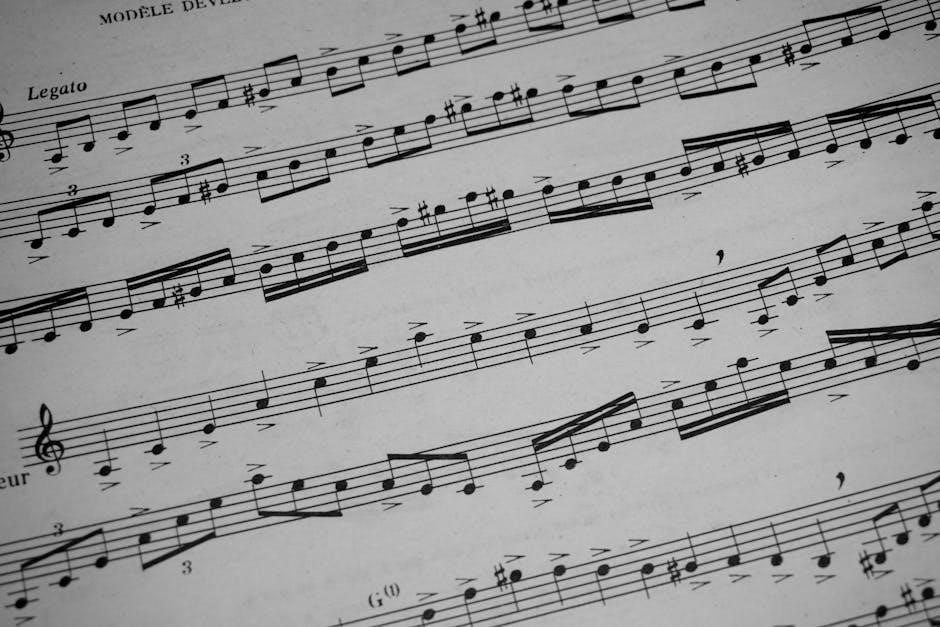
Decoding the sheet music for “Over the Rainbow,” particularly the Sheetsfree.com PDF, requires familiarity with standard musical notation. The arrangement utilizes treble clef for the vocal melody and employs common symbols for rhythm, pitch, and dynamics. Note values – whole, half, quarter, and eighth notes – dictate the duration of each sound. Time signature, though not explicitly stated in the provided excerpt, is crucial for understanding the rhythmic structure.
The sheet music features chord symbols above the melody line, indicating harmonic accompaniment. These include major (Cmaj7), minor (Am/C, Dm7), dominant (G7), and diminished (C dim7) chords. Slash chords (F/C, Dm7/C) signify a specific bass note. Understanding these symbols is vital for pianists and guitarists.
Pay attention to markings like rests, indicating silence, and repeat signs, guiding the performer through the song’s structure. The arrangement also includes nuanced chord voicings like G7(9) and D13/G, adding harmonic color. Familiarity with these elements unlocks a deeper understanding and more expressive performance of this iconic song.
Decoding Chord Symbols (F/C, Am/C, G7 etc.)

The “Over the Rainbow” sheet music from Sheetsfree.com utilizes a variety of chord symbols, each conveying specific harmonic information. Standard major chords like C and F are foundational. However, the arrangement frequently employs seventh chords (G7), adding a richer, more complex sound. The ‘7’ indicates the addition of a minor seventh interval to the triad.
Slash chords, such as F/C and Am/C, are particularly noteworthy. The symbol ‘/C’ denotes that C is the bass note, played lowest, while the chord above the slash (F or Am) is played higher. This creates a specific voicing and harmonic texture. Diminished chords (C dim7) introduce tension and instability, resolving beautifully to subsequent chords.
More complex chords like D9, G7sus, and D13/G further enrich the harmonic palette. ‘9’ signifies adding a ninth interval, ‘sus’ indicates a suspended chord, and ‘13’ adds a thirteenth. These voicings contribute to the song’s emotional depth. Understanding these symbols allows musicians to accurately reproduce the intended harmonic landscape of “Over the Rainbow.”
Identifying Time Signature and Tempo
Analyzing the “Over the Rainbow” sheet music, specifically the version available on Sheetsfree.com, reveals a common time signature of 4/4. This indicates four beats per measure, with the quarter note receiving one beat. This standard time signature provides a familiar and comfortable rhythmic foundation for the song, contributing to its lyrical and flowing quality.
Determining the precise tempo requires a bit more nuance. While the sheet music itself doesn’t explicitly state a beats-per-minute (BPM) marking, the song is traditionally performed at a moderate tempo, often around 66-88 BPM. This allows for expressive phrasing and emotional delivery. The arrangement lends itself to a ballad-like feel, prioritizing melodic clarity over rhythmic complexity.

Musicians should prioritize a tempo that allows for comfortable vocal delivery and expressive piano accompaniment. Experimentation within the 66-88 BPM range is encouraged to find a tempo that best suits individual interpretation and performance style. The 4/4 time signature provides a stable framework for this exploration, ensuring rhythmic coherence.
Tips for Learning to Play “Over the Rainbow” on Piano
Embarking on learning “Over the Rainbow” on piano, using the Sheetsfree;com PDF, begins with mastering the chord progression. Start slowly, focusing on smooth transitions between chords like C, F/C, Am/C, and G7. Practice each chord change repeatedly until it becomes automatic.
Break down the song into smaller sections. Don’t attempt to play the entire piece at once. Focus on mastering a few measures at a time, gradually increasing the tempo as you gain confidence. Pay close attention to the melody and try to incorporate it into your accompaniment.
Utilize online resources like YouTube tutorials to visualize finger placements and understand rhythmic nuances. Don’t be afraid to simplify the arrangement initially, focusing on the core chords and melody. As your skills improve, you can add embellishments and variations.
Consistent practice is key. Even short, focused practice sessions are more effective than infrequent, lengthy ones. Remember to listen to Judy Garland’s iconic performance for inspiration and to internalize the song’s emotional depth.
Vocal Performance Considerations
Performing “Over the Rainbow” vocally demands sensitivity and emotional connection. The song’s range, while not exceptionally wide, requires control and breath support, particularly during sustained notes. Studying Judy Garland’s interpretation is invaluable; her phrasing and dynamic variations are hallmarks of the song’s power.

The Sheetsfree.com sheet music provides a vocal chords edition, indicating the harmonic structure supporting the melody. Pay attention to the chord changes (F/C, Am/C, G7) and how they influence the melodic line. Use these changes to shape your phrasing and add depth to your performance.
Focus on conveying the song’s hopeful and yearning quality. The lyrics tell a story of dreams and escape, so imbue your performance with vulnerability and sincerity. Practice legato phrasing to create a smooth, flowing vocal line.

Consider the song’s dynamic range. Start softly, building to a powerful climax during phrases like “Somewhere over the rainbow way up high.” Experiment with vocal color and ornamentation to personalize your interpretation while respecting the song’s inherent beauty.
Accompaniment Styles and Variations
The harmonic structure of “Over the Rainbow,” as presented in the Sheetsfree.com PDF sheet music, lends itself to diverse accompaniment styles. A simple piano arrangement focusing on the chord progression (C, F/C, Am/C, G7) provides a classic foundation.
However, variations are readily achievable. Incorporating arpeggios or broken chords adds texture and movement. A jazz-influenced approach could utilize seventh chords (Cmaj7, Dm7, G7) and subtle rhythmic variations. Experimenting with inversions (e.g., C6) can create a smoother harmonic flow.
Beyond piano, the song adapts beautifully to guitar or ukulele arrangements; Fingerpicking patterns can enhance the song’s delicate quality, while strumming provides a fuller sound. Consider adding a walking bass line to create a more sophisticated accompaniment.
For larger ensembles, string arrangements or subtle orchestral textures can elevate the song’s emotional impact. Regardless of the chosen style, prioritize supporting the vocal melody and enhancing the song’s overall mood. The key is to complement, not overshadow, the vocal performance.
Finding Tutorials and Resources Online
Numerous online resources cater to musicians learning “Over the Rainbow,” complementing the PDF sheet music from sites like Sheetsfree.com and Musicnotes.com. YouTube is a treasure trove, offering piano tutorials ranging from beginner-friendly walkthroughs to advanced masterclasses.
Search terms like “Over the Rainbow piano tutorial,” “Over the Rainbow guitar chords,” or “Over the Rainbow vocal cover” yield a wealth of options. Many tutorials visually demonstrate finger placements, chord voicings, and rhythmic patterns.
Websites dedicated to music education, such as Flowkey or Skoove, provide interactive lessons and personalized feedback. Online forums and communities, like Reddit’s r/piano or ukulele-specific groups, offer opportunities to ask questions and share experiences.
Furthermore, websites offering chord diagrams and song analysis can deepen understanding of the song’s harmonic structure. Don’t overlook the potential of online vocal coaching resources to refine your interpretation. Utilizing a combination of these resources will accelerate your learning process and enhance your performance.
Common Mistakes to Avoid When Playing
When tackling “Over the Rainbow” using PDF sheet music from sources like Sheetsfree.com or Musicnotes.com, several common pitfalls can hinder a smooth performance. A frequent error is rushing the tempo, especially during the introductory phrases; maintaining a gentle, flowing pace is crucial.
Incorrectly interpreting the chord voicings – particularly those with slash chords like F/C or Am/C – can muddy the harmonic texture. Ensure the indicated bass note is accurately played. Beginners often struggle with the smooth transitions between chords, leading to choppy playing.
Neglecting dynamics is another common mistake. The song benefits from subtle variations in volume to convey emotion. Pay attention to the phrasing and breathe naturally when singing or playing. Ignoring the time signature (typically 4/4) can disrupt the rhythmic flow.
Finally, attempting the song beyond your current skill level can be discouraging. Start slowly, focus on accuracy, and gradually increase the tempo. Consistent practice and attention to detail will overcome these challenges.
Different Key Signatures and Transposition
While many “Over the Rainbow” PDF sheet music versions, like those found on Sheetsfree.com, are presented in C major, exploring different key signatures can significantly impact the song’s feel and vocal suitability. Transposition—shifting the entire piece to a new key—is a valuable skill for pianists and vocalists.
For singers with a lower range, transposing to a key like Bb major or even A major can make the melody more comfortable. Conversely, higher vocal ranges might benefit from a transposition to D major or Eb major. Understanding key signatures allows for personalized adaptation.
When transposing, remember to adjust all chords accordingly. A C major chord becomes a D major chord when transposed up a whole step. Utilizing online transposition tools or music theory knowledge is essential for accurate results.
Experimenting with different keys can reveal new nuances in the harmony and melody. However, always consider the original intent of the composer and the song’s emotional impact when choosing a new key. Sheet music often doesn’t include transposed versions, making this skill crucial.
Sheet Music for Different Instruments (Guitar, Ukulele)
Beyond piano and vocal arrangements, “Over the Rainbow” sheet music is widely available for guitar and ukulele, expanding its accessibility to a broader range of musicians. While Sheetsfree.com primarily focuses on piano/vocal scores, numerous websites specialize in guitar and ukulele transcriptions.
Guitar sheet music often presents the melody with chord diagrams, enabling strumming or fingerpicking accompaniment. Tabs (tablature) are also common, simplifying the learning process for guitarists unfamiliar with standard notation. Ukulele arrangements typically utilize simplified chord progressions suitable for the instrument’s four strings.
When selecting sheet music for guitar or ukulele, consider your skill level. Beginner arrangements often feature simplified chords and rhythms, while more advanced versions incorporate complex techniques like fingerstyle patterns or extended chords.
Adapting piano sheet music for guitar or ukulele requires some musical understanding. Identifying the melody and harmonic structure allows for creating a suitable arrangement. Online resources and tutorials can assist with this process, offering guidance on chord voicings and strumming patterns. The song’s beauty transcends instrumentation.
The Song’s Enduring Appeal Today
“Over the Rainbow” continues to resonate deeply with audiences across generations, solidifying its status as a timeless classic. Its universal themes of hope, longing, and the pursuit of dreams transcend cultural boundaries, making it a beloved song worldwide. The availability of sheet music, including accessible PDF versions from sites like Sheetsfree.com and Musicnotes.com, contributes to its continued performance and appreciation.
The song’s emotional depth and lyrical beauty invite interpretation and adaptation, inspiring countless covers and arrangements. From jazz standards to contemporary pop renditions, “Over the Rainbow” remains a staple in diverse musical genres. Its enduring popularity is also fueled by its association with Judy Garland’s iconic performance in The Wizard of Oz.
The ease of accessing sheet music allows aspiring musicians to learn and perform this cherished song, perpetuating its legacy. Whether played on piano, guitar, or ukulele, “Over the Rainbow” evokes a sense of nostalgia and wonder. Its message of optimism continues to inspire, reminding us to believe in the possibility of a brighter future.